Student Loan Repayment 2026: Federal Updates & $1,000+ Savings Guide

Understanding student loan repayment in 2026 is crucial for federal borrowers, as new program updates offer significant opportunities to reduce monthly payments and potentially save over $1,000 annually through strategic planning and enrollment in revised income-driven repayment plans.
Navigating the landscape of federal student loan repayment can often feel like a complex maze, but with the right information, borrowers can unlock substantial savings. Our comprehensive guide to student loan repayment in 2026 is designed to help you understand upcoming federal program updates and identify strategies that could save you over $1,000 annually.
understanding the current federal student loan landscape
The federal student loan system has undergone significant changes in recent years, with more updates anticipated for 2026. These changes are designed to make repayment more manageable for millions of borrowers, particularly those struggling with high monthly payments or low incomes. Understanding the foundation of these programs is the first step toward optimizing your repayment strategy.
Prior to 2026, borrowers primarily navigated a mix of standard repayment plans, graduated plans, extended plans, and various income-driven repayment (IDR) options. Each plan had its own set of rules regarding eligibility, payment calculation, and loan forgiveness timelines. The complexity often led to confusion, and many borrowers found themselves in plans that weren’t ideally suited to their financial circumstances.
the shift towards simplified repayment
The trend in federal student loan policy has been towards simplification and increased affordability. This shift aims to reduce default rates and provide a clearer path to loan forgiveness for eligible borrowers. The introduction of new or revised IDR plans plays a central role in this effort, offering more generous terms and streamlined processes.
- Income-Driven Repayment (IDR) Plans: These plans calculate your monthly payment based on your income and family size, rather than your loan balance.
- Payment Caps: IDR plans often cap your monthly payment at an affordable percentage of your discretionary income.
- Loan Forgiveness: After a certain number of years of qualifying payments (typically 20 or 25 years), any remaining balance on your loans may be forgiven.
The federal government’s commitment to improving student loan repayment options reflects a broader recognition of the economic challenges many graduates face. By offering more flexible and affordable paths, the goal is to alleviate financial stress and enable borrowers to achieve greater financial stability.
In summary, the current federal student loan landscape, leading into 2026, is characterized by an evolving set of programs designed to be more borrower-friendly. Staying informed about these changes is paramount to making the most of available benefits and avoiding common pitfalls.
the save plan: a game-changer for 2026
Among the most impactful federal program updates for student loan repayment in 2026 is the full implementation and refinement of the Saving on a Valuable Education (SAVE) Plan. This plan, which began rolling out in 2023, is set to offer even more significant benefits to borrowers by 2026, potentially saving them thousands of dollars over the life of their loans.
The SAVE Plan replaces the Revised Pay As You Earn (REPAYE) Plan and offers more generous terms, particularly for low- and middle-income borrowers. Its core principle is to make monthly payments more affordable by adjusting the calculation of discretionary income and providing interest subsidies. This means that for many, their monthly payment could be significantly lower than under previous IDR plans.
key benefits and features of the save plan
The SAVE Plan’s enhancements are multifaceted, touching upon various aspects of loan repayment:
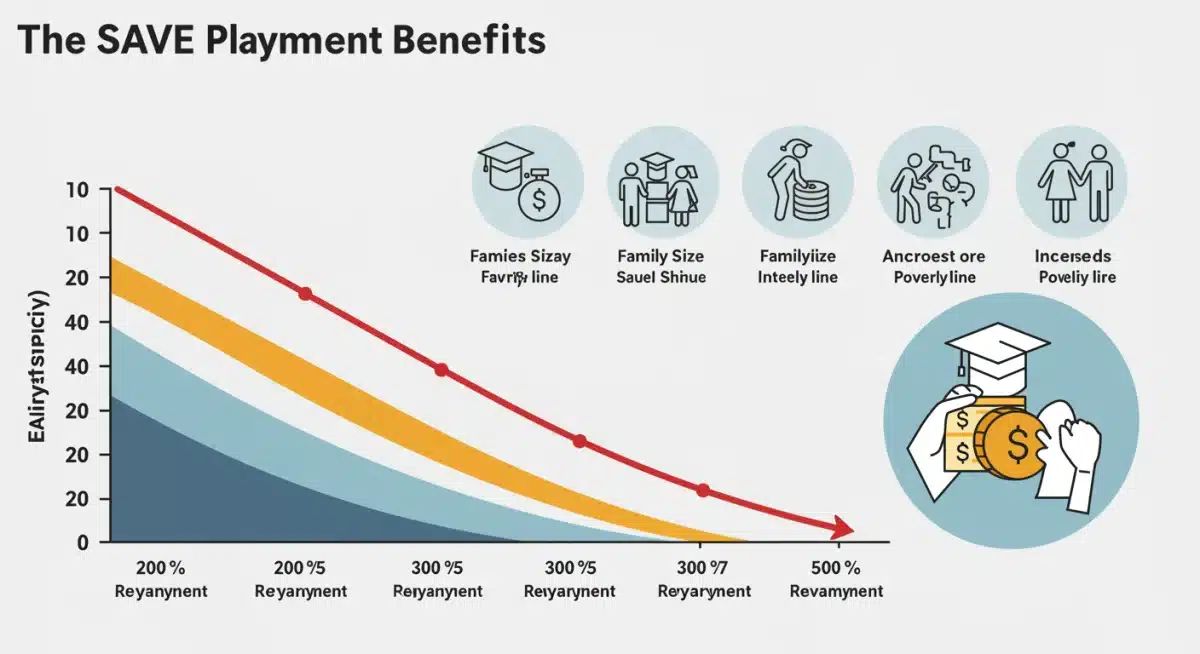
- Increased Income Exemption: The amount of income protected from payment calculations is raised from 150% to 225% of the federal poverty line. This means more of your income is considered non-discretionary, leading to lower payments.
- Interest Subsidy: If your calculated monthly payment doesn’t cover the full amount of interest due, the government covers the remaining interest. This prevents your loan balance from growing due to unpaid interest, a common issue with other IDR plans.
- Lower Payment for Undergraduate Loans: For undergraduate loans, monthly payments are reduced from 10% to 5% of discretionary income. This change, fully effective by July 2024 but impacting long-term savings through 2026 and beyond, dramatically lowers payments for many.
These features combine to create a powerful tool for managing student loan debt. The interest subsidy, in particular, is a significant departure from previous IDR plans, which often saw loan balances swell even as borrowers made regular payments.
Consider a borrower with a $30,000 student loan balance and an adjusted gross income (AGI) of $40,000. Under the previous REPAYE plan, their payment might be higher, and interest could accrue. Under SAVE, their payment could be substantially lower, and any unpaid interest would be covered, preventing balance growth. This difference can easily translate to over $1,000 in annual savings.
The SAVE Plan represents a fundamental shift in how federal student loans are repaid, prioritizing affordability and preventing runaway interest. Borrowers should actively investigate their eligibility and consider enrolling to maximize their savings.
strategizing for over $1,000 in annual savings
Achieving significant savings on your student loans by 2026 requires a proactive and informed approach. While the SAVE Plan is a major component, combining it with other strategies can amplify your financial benefits, potentially exceeding $1,000 in annual savings.
The first step is always to understand your current loan portfolio. Knowing your loan types (federal vs. private), interest rates, and current repayment plan provides the necessary foundation for strategic decision-making. Federal loans offer the most flexibility and access to programs like SAVE, whereas private loans have different terms and fewer government-backed protections.
key strategies for maximizing savings
- Enroll in the SAVE Plan: As discussed, this is likely the single most impactful step for many federal borrowers. The reduced payments and interest subsidy are substantial.
- Recertify Annually: For any IDR plan, including SAVE, you must recertify your income and family size annually. Failing to do so can result in higher payments or capitalization of interest.
- Consolidate Federal Loans: If you have older federal loans (like FFEL Program loans) that aren’t eligible for the SAVE Plan, consolidating them into a Direct Consolidation Loan can make them eligible. This can also help you qualify for Public Service Loan Forgiveness (PSLF) if applicable.
- Explore Public Service Loan Forgiveness (PSLF): If you work for a qualifying non-profit or government organization, PSLF can forgive your remaining federal student loan balance after 120 qualifying monthly payments. Payments made under IDR plans, including SAVE, count towards PSLF.
Beyond these federal programs, consider your overall financial picture. Even if your monthly payment is low under SAVE, making extra payments when possible can reduce the principal faster, especially on loans with higher interest rates not fully subsidized. However, always prioritize building an emergency fund before making extra loan payments.
Another often overlooked strategy is optimizing your tax filings. Your adjusted gross income (AGI) directly impacts your IDR payment. Consulting a tax professional to understand how deductions and credits affect your AGI could indirectly lower your student loan payments. For instance, contributing to tax-advantaged retirement accounts can reduce your AGI.
By diligently applying these strategies, borrowers can significantly reduce their financial burden and realize substantial annual savings, making student loan repayment a more manageable part of their financial lives.
federal program updates beyond save for 2026
While the SAVE Plan is a cornerstone of federal student loan repayment in 2026, other significant program updates and considerations are also in play. These changes aim to address long-standing issues within the federal student aid system, providing more equitable and efficient pathways for borrowers.
One notable area of focus is the continued effort to rectify past administrative errors that negatively impacted borrowers, particularly concerning IDR payment counts and forbearance periods. The Department of Education has been undertaking initiatives to conduct a one-time adjustment of IDR payment counts, which could bring many borrowers closer to loan forgiveness.
important policy adjustments and their implications
Several policy adjustments are designed to benefit borrowers:
- IDR Account Adjustment: This initiative reviews past payment records to correct errors and count more periods of repayment and certain types of forbearance towards loan forgiveness under IDR plans and PSLF. This could fast-track forgiveness for many.
- Streamlined PSLF Process: Efforts are underway to simplify the Public Service Loan Forgiveness program, making it easier for eligible public servants to navigate the application process and receive the forgiveness they’ve earned.
- Fresh Start Initiative: While primarily focused on helping borrowers in default, the Fresh Start initiative has broader implications for those looking to get back on track. It removes the default status from eligible loans, restoring access to federal student aid and new repayment plans like SAVE.
These updates signal a comprehensive approach by the federal government to overhaul the student loan system. The goal is to ensure that borrowers who have met the requirements for IDR or PSLF receive the benefits they are due, and that future borrowers have a clearer, more supportive framework for managing their debt.
Borrowers should regularly check the official Federal Student Aid website (studentaid.gov) for the latest information on these adjustments. Eligibility criteria and application processes can evolve, and staying current is essential to taking full advantage of all available benefits. These federal program updates, combined with the SAVE Plan, create a robust support system for managing student loan debt in 2026.
eligibility and enrollment for federal repayment programs
Understanding who qualifies for federal repayment programs and how to enroll is critical to accessing their benefits. While the specific requirements can vary slightly between plans, there are common threads that apply to most federal student loan programs, especially the SAVE Plan.
Generally, only federal student loans are eligible for income-driven repayment plans and loan forgiveness programs. This includes Direct Subsidized Loans, Direct Unsubsidized Loans, Direct PLUS Loans (for graduate students and parents, though parent PLUS loans have specific consolidation requirements for IDR eligibility), and Direct Consolidation Loans. Older federal loans, such as FFEL Program loans, often need to be consolidated into a Direct Consolidation Loan to become eligible.
step-by-step enrollment guide
- Gather Your Documents: You’ll need your Federal Student Aid (FSA) ID, personal income information (e.g., tax returns or pay stubs), and family size details.
- Visit StudentAid.gov: The official Federal Student Aid website is where you apply for or change your repayment plan. Navigate to the ‘Repayment’ section and look for ‘Income-Driven Repayment Plan Request.’
- Select Your Plan: The application will guide you through choosing the best IDR plan for your situation. The SAVE Plan will be an option if you are eligible.
- Submit Your Application: Carefully review all information before submitting. You may be able to sign electronically using your FSA ID.
After enrollment, it’s crucial to understand your responsibilities. You will need to recertify your income and family size annually. Your loan servicer will typically send reminders, but it’s wise to mark your calendar. Failure to recertify can lead to your payments increasing dramatically or capitalization of interest, undermining the benefits of the plan.
If your financial circumstances change significantly during the year (e.g., job loss, reduction in income, increase in family size), you can request an early recertification to potentially lower your monthly payments. Don’t wait for your annual recertification date if your situation has worsened.
By actively managing your enrollment and staying on top of recertification, you can ensure continuous access to the benefits of federal repayment programs and maintain your path toward financial relief and potential loan forgiveness.
avoiding common pitfalls and optimizing your repayment journey
Even with the most generous federal programs, borrowers can encounter challenges or miss opportunities if they’re not vigilant. Avoiding common pitfalls is just as important as understanding the benefits, ensuring your student loan repayment journey in 2026 is as smooth and cost-effective as possible.
One of the most frequent mistakes is ignoring communication from your loan servicer. Important notices about recertification, program changes, or payment adjustments are often sent via email or postal mail. Failing to read and act on these communications can lead to missed deadlines and unexpected payment increases.
critical mistakes to sidestep
- Missing Annual Recertification: This is perhaps the biggest pitfall for IDR plan participants. If you don’t recertify your income and family size annually, your payments could revert to the standard plan amount, often much higher, and any unpaid interest might capitalize.
- Not Consolidating Eligible Loans: Borrowers with older FFEL Program loans who want to access the full benefits of the SAVE Plan or PSLF must consolidate them into a Direct Consolidation Loan. Delaying this can mean missing out on significant savings or forgiveness opportunities.
- Ignoring PSLF Eligibility: Many public sector and non-profit employees are eligible for Public Service Loan Forgiveness but fail to track their qualifying employment and payments. Use the PSLF Help Tool on StudentAid.gov regularly.
- Not Updating Contact Information: If your address, email, or phone number changes, update it with your loan servicer and on StudentAid.gov. This ensures you receive critical information.
Another crucial aspect is understanding the difference between federal and private student loans. Federal programs and protections, including IDR plans and forgiveness, do not apply to private loans. If you have private loans, you’ll need to explore different strategies, such as refinancing, which comes with its own set of considerations.
Regularly reviewing your loan details on StudentAid.gov is a good practice. This allows you to verify your loan types, current servicer, payment history, and eligibility for various programs. Being informed and proactive is your best defense against potential issues and your strongest asset in optimizing your repayment journey.
By avoiding these common errors and staying engaged with your student loan management, you can maximize your savings and successfully navigate the complexities of federal repayment programs in 2026.
projecting your savings: more than $1,000 annually
The promise of saving over $1,000 annually on student loan repayment in 2026 is not an exaggeration for many borrowers; it’s a tangible outcome achievable through strategic planning and leveraging federal program updates. Understanding how these savings materialize can motivate and guide your actions.
The primary driver for these substantial savings is the SAVE Plan. Its combination of a higher income exemption and an interest subsidy fundamentally changes the math of student loan repayment. For example, if your previous monthly payment was $250 under an older IDR plan, and under SAVE it drops to $150, that’s an immediate annual saving of $1,200 ($100 x 12 months).
calculating your potential benefits
- Income Level: Lower incomes benefit more from the increased income exemption under SAVE, leading to lower monthly payments.
- Family Size: A larger family size further increases the income exemption, reducing your discretionary income and thus your payment.
- Loan Balance and Interest Rate: While SAVE caps payments based on income, the interest subsidy prevents balances from growing, which is a massive long-term saving, especially for those with high balances and interest rates.
- Undergraduate vs. Graduate Loans: Undergraduate loans benefit from the 5% discretionary income payment cap, while graduate loans remain at 10%.
Consider a single borrower with $40,000 in undergraduate loans at a 6% interest rate, earning $45,000 annually. Under the old REPAYE plan, their payment might be around $200-$250, with some interest possibly accruing. Under SAVE, their payment could drop to $50-$100, and any unpaid interest would be covered. This difference alone could easily exceed $1,000 annually, not just in direct payment reduction but also in preventing balance growth.
Beyond the direct payment reduction, the long-term benefit of the interest subsidy cannot be overstated. For many, seeing their loan balance grow despite making payments was a demoralizing experience. The SAVE Plan eliminates this, meaning every payment moves you closer to paying off your loan or achieving forgiveness, saving you from years of accrued interest.
Furthermore, if you qualify for PSLF, the combination of low payments under SAVE and eventual forgiveness after 10 years of public service can lead to tens of thousands of dollars in savings over the life of your loans. Projecting your savings involves using the loan simulator on StudentAid.gov and carefully inputting your financial details to see personalized estimates. This tool is invaluable for understanding the specific impact of the SAVE Plan and other options on your financial future.
By actively engaging with these tools and understanding the mechanics of the new programs, borrowers can confidently project and realize significant annual savings, transforming their approach to student loan repayment in 2026.
| Key Program/Strategy | Brief Description |
|---|---|
| SAVE Plan | Income-driven repayment plan with higher income exemption, lower payments for undergrads, and 100% interest subsidy. |
| IDR Account Adjustment | One-time review correcting past payment counts, bringing more borrowers closer to loan forgiveness. |
| PSLF Pathway | Forgiveness for public service workers after 120 qualifying payments, often enhanced by SAVE Plan benefits. |
| Annual Recertification | Mandatory yearly update of income and family size to maintain eligibility and optimized IDR payments. |
frequently asked questions about student loan repayment in 2026
The SAVE Plan is an income-driven repayment plan that significantly lowers monthly payments for many federal student loan borrowers. By 2026, it offers a higher income exemption (225% of poverty line) and a 100% interest subsidy, meaning your balance won’t grow due to unpaid interest, potentially saving you over $1,000 annually.
Yes, many federal student loan borrowers can save over $1,000 annually. This is primarily achieved through enrolling in the SAVE Plan, which can drastically reduce monthly payments and prevent interest capitalization. Combining this with strategic loan consolidation or PSLF can further amplify your savings.
Most federal student loans are eligible, including Direct Subsidized, Unsubsidized, and PLUS loans. Older federal loans, like FFEL Program loans, typically need to be consolidated into a Direct Consolidation Loan first to become eligible for the SAVE Plan and its benefits.
The IDR account adjustment is a one-time initiative by the Department of Education to correct past errors in payment counting. It reviews your payment history to count more periods of repayment and certain forbearances towards loan forgiveness under IDR plans and PSLF, potentially accelerating your path to debt relief.
If you fail to recertify your income and family size annually for an IDR plan, your monthly payments will likely increase significantly, reverting to the standard repayment amount. Additionally, any unpaid interest that was previously subsidized might capitalize, meaning it will be added to your principal balance.
conclusion
The landscape of federal student loan repayment in 2026 presents unprecedented opportunities for borrowers to manage their debt more effectively and achieve substantial financial savings. The full implementation of the SAVE Plan, coupled with ongoing administrative adjustments like the IDR account review and a streamlined PSLF process, collectively provides a robust framework for reducing monthly burdens and accelerating the path to loan forgiveness. By proactively engaging with these programs, understanding eligibility requirements, and avoiding common pitfalls, borrowers can strategically navigate their repayment journey. The potential to save over $1,000 annually is a tangible reality for many, underscoring the importance of staying informed and taking decisive action to optimize your student loan repayment strategy in the coming years.